Automated dispatch: A game changer for groupage logistics
Many logistics companies struggle to find good dispatchers, especially for night shifts. And when experienced team members retire, the challenge goes beyond finding a successor: valuable know-how leaves the company with them. Facing these challenges, Finsterwalder decided to fully automate its overnight dispatch with PTV OptiFlow.



Company
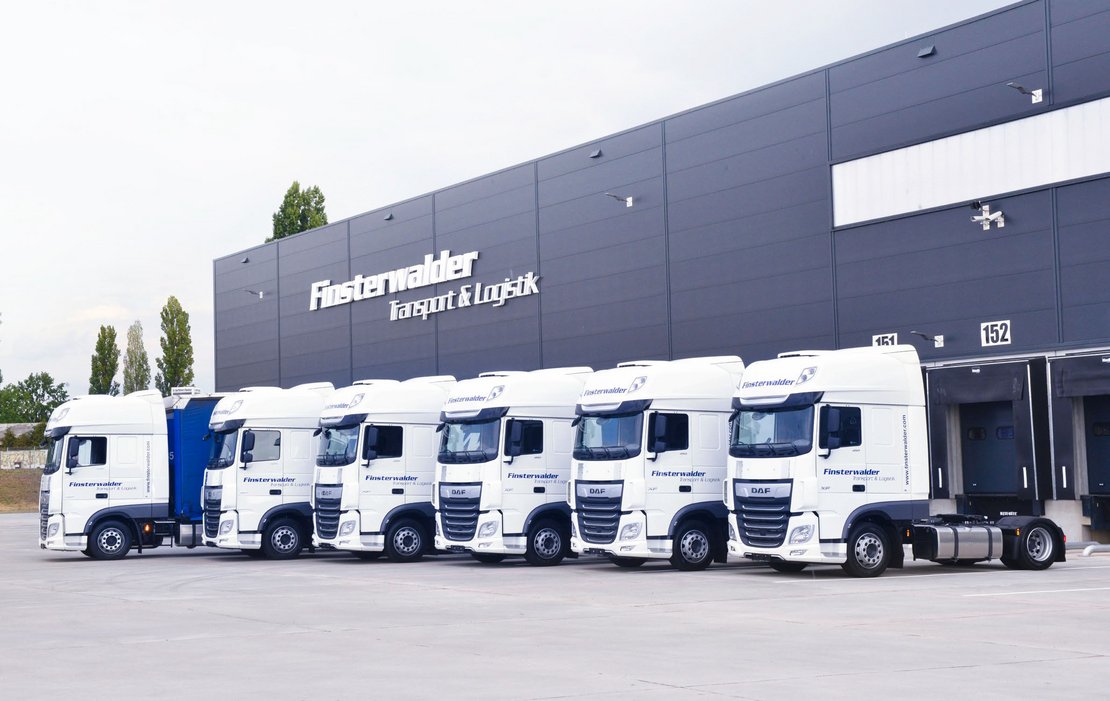
Finsterwalder – Family of Logistics is an owner-managed family business headquartered in Türkheim (Allgäu), with additional locations across Germany. At its Halle (Saale) branch, Finsterwalder handles groupage shipments within the CargoLine network. In its forwarding business, the company dispatches more than 700 vehicle units, around 260 of them its own fleet, with additional capacity provided by dedicated subcontracted vehicles. Across all locations, Finsterwalder operates approximately 500,000 m² of indoor warehouse space and about 110,000 m² of outdoor storage.
Starting point and challenges
Groupage logistics is defined by high variability, numerous constraints, and tight schedules. In Halle, Finsterwalder typically receives network shipments overnight between midnight and 6:00 a.m. On average, the branch handles around 700 shipments per day, typically about 1,100 packages with a total weight of roughly 200 metric tons, with significant fluctuations. All planning has to happen within a very narrow dispatch window: starting at around 10:00 p.m. and finishing by about 6:00 a.m., which leaves an effective eight hours for overnight planning.
The operational complexity comes not only from "hard" constraints such as payload, opening hours, and vehicle types, but above all from "soft" requirements that determine whether a route plan actually works in practice. These include route knowledge as well as driver and customer preferences. For efficiency, stops should be kept as close together as possible, and vehicles should unload as much as possible before picking up new freight. Ultimately, the goal is to plan routes that work in the real world, not just on a computer.
Initially, much of the relevant know-how at Finsterwalder lived in the heads of individual dispatchers and drivers. This created dependencies, and whenever someone was absent, service quality and stability were immediately at risk.
"For example, one of the businesses we deliver to takes a breakfast break at 10:00 every day. If we show up at that time, nobody opens the gate. The responsible dispatcher knew this from experience and planned routes to that customer accordingly. But what happens when he's on vacation and someone else steps in? That's why it was so important for us to centralize this kind of siloed knowledge in one place," says Christian Reichelt, Project Manager, Corporate Development at Finsterwalder.
Embracing more automation
To further automate route planning while better reflecting the specific requirements of groupage logistics, Finsterwalder moved from a largely manual use of PTV Route Optimizer to PTV OptiFlow. While PTV Route Optimizer reliably handled the "hard" constraints, the team saw its limits mainly in modeling gray areas, trade-offs, and priorities. For example, small shipments should preferably be assigned to smaller vehicles, and pickups should ideally be placed in the middle or at the end of a route. Route durations also needed more flexibility, for instance when a few extra minutes of driving time allow one more stop to be served.
The rollout of the new PTV Logistics solution began with a joint one-day "Value Check" workshop. Using real shipment and route data, the teams built an initial model and benchmarked it against the current setup. This was followed by a pilot phase, in which Finsterwalder loaded its own data into the solution and refined parameters and constraint logic step by step. To validate the results in live overnight operations and build trust among dispatchers, the company then ran both systems in parallel. First, dispatchers continued planning in PTV Route Optimizer, while PTV OptiFlow generated comparison plans afterward. This phase lasted about one to one and a half weeks. In the second phase, the team reversed the process, using PTV OptiFlow first and keeping PTV Route Optimizer as a fallback. The fallback was never needed.
The results

4 hours instead of 14 for route planning

50% fewer dispatchers needed on the night shift

100% consistent route planning
Results
The most immediate, measurable impact was on dispatch time. Overnight planning previously required two dispatchers, who together spent around 12 hours on dispatching alone. With PTV OptiFlow, a typical night now takes one dispatcher about four hours. Upstream manual tasks, such as separately pre-planning pickups the day before, were also eliminated. As a result, total effort dropped from around 14 hours to about four.
"These time savings are critical for us, not because we want to replace existing jobs, but because the industry is facing a serious shortage of dispatchers. On top of that, we work at night, which simply isn't an option for many people. And with so many logistics employees approaching retirement age, more automation is the only viable path forward for us and an important step toward future-proofing our business," says Reichelt.
Beyond saving time, the focus was on consistent day-to-day quality. Previously, results depended heavily on who was dispatching: routes were built differently, drivers received changing stop sequences and territories, and operational issues such as overplanning or infeasible stop sequences occurred more often. PTV OptiFlow delivers far more consistent planning results. Constraints, opening hours, and routing logic are built into the plan from the start, producing drivable routes instead of pushing problems downstream into execution. This improves predictability and process stability and, in turn, service levels for customers and network partners.
Another benefit is greater organizational resilience. Many implicit rules, including customer-specific requirements, driver preferences, and local knowledge, were previously tied to individual people rather than documented in the system. By gradually capturing these rules in PTV OptiFlow, Finsterwalder is moving knowledge out of people's heads and into the system. This reduces dependence on individual dispatchers and makes it easier to cover absences, because planning becomes reproducible and stand-ins no longer have to start from scratch.
Consistent system-based planning also revealed discrepancies that can go unnoticed in daily operations for a long time. These included cases where certain drivers couldn't run specific routes, or where historical agreements imposed operational limits, such as a cap of 17 stops per route. Over time, even anecdotal customer specifics can be captured as structured rules. This not only improves plan quality but also creates a foundation for actively cleaning up processes, agreements, and data.
Looking ahead, Finsterwalder considers near-fully automated dispatch with only a few targeted manual interventions to be realistic. At the same time, the project showed that the biggest effort isn't the software implementation itself. According to the team, more than half of the work goes into the underlying data (addresses, opening hours, weights and pallet spaces, vehicle master data) and keeping it up to date, especially in a network environment. The human factor is just as important: dispatchers and drivers need to trust the results and be able to explain any deviations.
"Data really is the foundation for everything. Without it, every effort to gain efficiency with software or AI will fall flat," says Reichelt.
Conclusion
With PTV OptiFlow, Finsterwalder's Halle branch now plans routes much faster and more reliably, has reduced its dependence on individual employees, and has gained clear visibility into gaps in its data and processes. This puts the company in a strong position to manage groupage dispatch within a tight overnight window more reliably and to keep automating step by step.
See PTV OptiFlow in Action
Book your live demo and discover the future of route planning and optimization with PTV OptiFlow.