Search for content
Transport Planning

Multi depot routing at scale: planning thousands of stops across many depots

US parcel volume reached 22.4 billion shipments in 2024, up 3.4 percent on the prior year, according to the Pitney Bowes Parcel Shipping Index. The depots, vehicles and drivers that absorb that growth stay limited, while the number of routes a planner could build from the same orders grows far faster. 

Multi depot routing at scale is about handling that growth: producing feasible, cost efficient routes for thousands of stops across several depots, and producing them again quickly when the day changes. This page covers what changes as a multi depot network grows, what a good routing setup has to deliver, and how to test one on your own data. 

Talk to an expert 

What is multi depot routing at scale? 

Multi depot routing at scale is the ability to build feasible, cost efficient routes for thousands of stops across several depots within a practical time limit, and to rebuild them quickly when orders, traffic or vehicles change. 

In academic terms, building routes from several depots is the multi depot vehicle routing problem: deciding which depot and vehicle serves each stop, and in which sequence, while respecting capacities, time windows and driver rules. A handful of depots and a few hundred stops can be solved and checked with modest effort. Scale changes three things: the number of stops, the number of constraints that interact, and the time available to produce a plan. 

Aspect

Small network 

At scale 

Stops per run A few hundred, with plans reviewed route by route Thousands, with review shifting to exceptions and key metrics 
ConstraintsA handful, easy to reason about Time windows, capacities, driver hours, vehicle types and depot limits that interact 
Planning window Waiting a few minutes is acceptable Plans must finish inside a fixed window, and again whenever changes arrive 
Travel times A single average per road can pass Time of day effects add up across thousands of legs 
SystemsOrders handled in one tool or a spreadsheet Orders, vehicles and plans move between the TMS, ERP and routing engine 

The question of which depot should serve which customer sits one step earlier than routing. To know more about how orders are allocated to depots before routes are built, see multi depot distribution planning. 

Why scale changes the problem 

Four things grow together as a network grows, and each one makes the others harder to manage: 

  • Possible plans
    Vehicle routing belongs to a class of problems (NP hard) for which no known method guarantees the best answer quickly as the problem grows. Practical software uses heuristics that search for very good plans within a time limit, so plan quality depends on how well that search is designed. 
  • Travel time data
    A routing engine needs travel times between locations. The number of origin and destination pairs grows with the square of the number of locations, so for instance - 5,000 locations mean 25 million pairs. 
  • Interacting constraints
    Time windows, vehicle capacity, driver hours, vehicle types and depot capacity each look manageable alone. Together they rule out most of the plans that look good on a map. 
  • Depot boundaries
    Orders near the boundary between two depots can go either way. When depots are planned separately, these orders are fixed by a rule decided in advance, and the cost of that rule stays hidden inside per depot reports. 

At small scale a weaker method still produces a plan that looks fine. At large scale the same method can return a plan that respects every constraint yet carries avoidable miles, with no warning attached. Testing on real data is the dependable way to find out, and the checklist further down shows how. 

Planners and IT teams feel this from different sides. A transport planner sees a plan too large to review route by route, which makes trust in the result depend on how clearly the plan can be explained. An IT architect sees an engine that has to deliver results inside a nightly batch window and return them to the TMS without manual steps. 

What good routing looks like at scale 

Seven qualities separate a routing setup that holds up at volume from one that only works in a demo: 

Loaded truck

Feasible plans

Every time window, capacity limit and driver rule is respected, with no manual repair afterwards

Faster planning

Realistic travel times

Travel times reflect when a vehicle drives, not a single average per road

Multiple destinations

Depot assignment and routing solved together

Orders are not locked to a depot before routes are known

Delivery time

Bounded run time

A complete plan arrives inside the planning window, every time

Collaboration values

Stable replans

When an order changes, the affected routes change and the rest stay in place

Case study

Explainable results

Planners can see why an order was left unplanned and what would change that

Seamless integration

Clean integration

Orders flow in from the TMS or ERP and plans flow back without re keying

How PTV Logistics approaches multi depot routing 

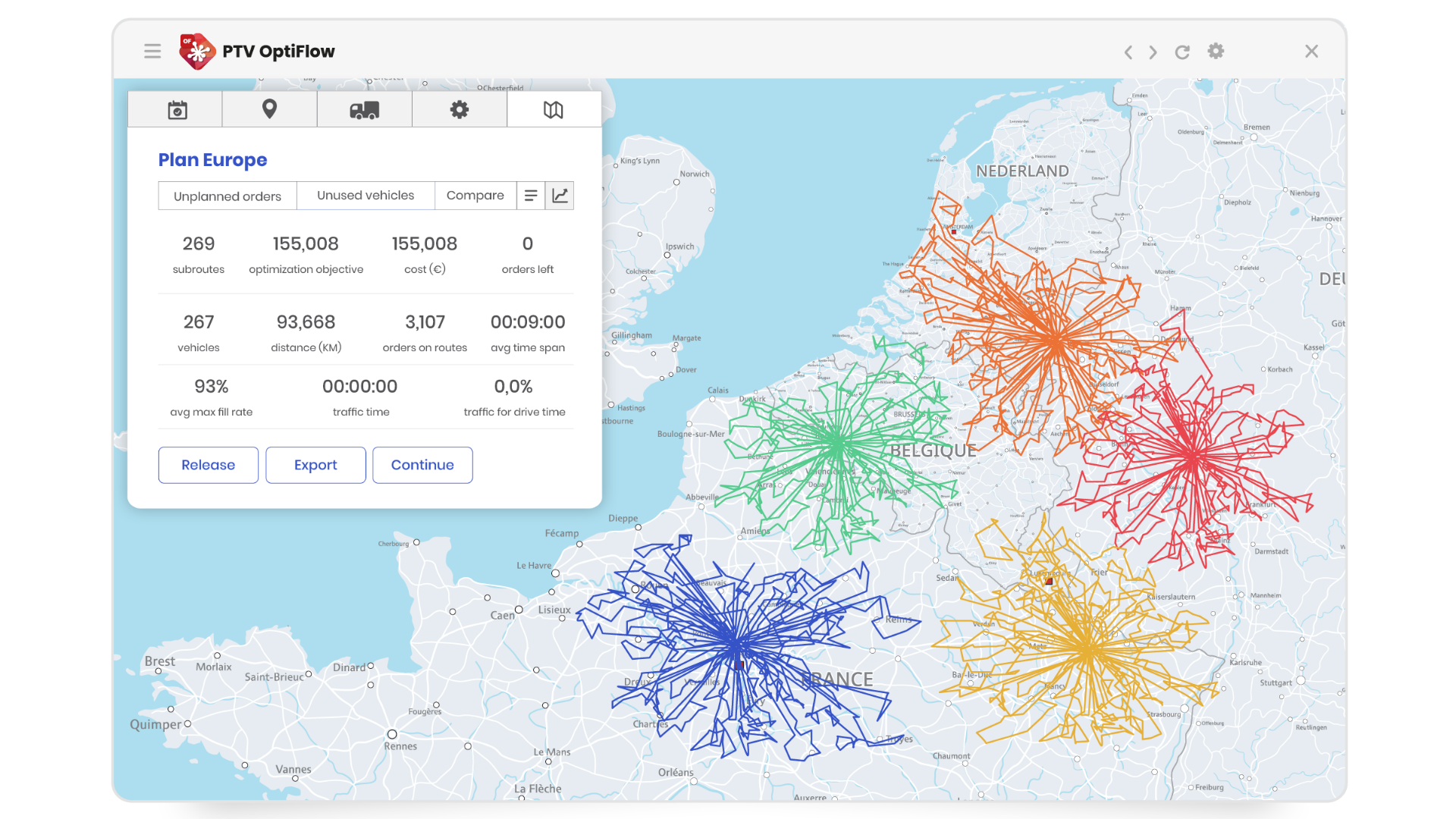
PTV OptiFlow plans across multiple stops, multiple depots and dense constraints. It optimizes depot assignments and routes simultaneously, and it calculates travel times from traffic patterns built on historical traffic data from millions of road users, so planned times reflect the time of day and the day of the week. 

To know more about how PTV OptiFlow plans depots and routes together, see integrated depot and route optimization with PTV OptiFlow. 
Explore PTV OptiFlow 

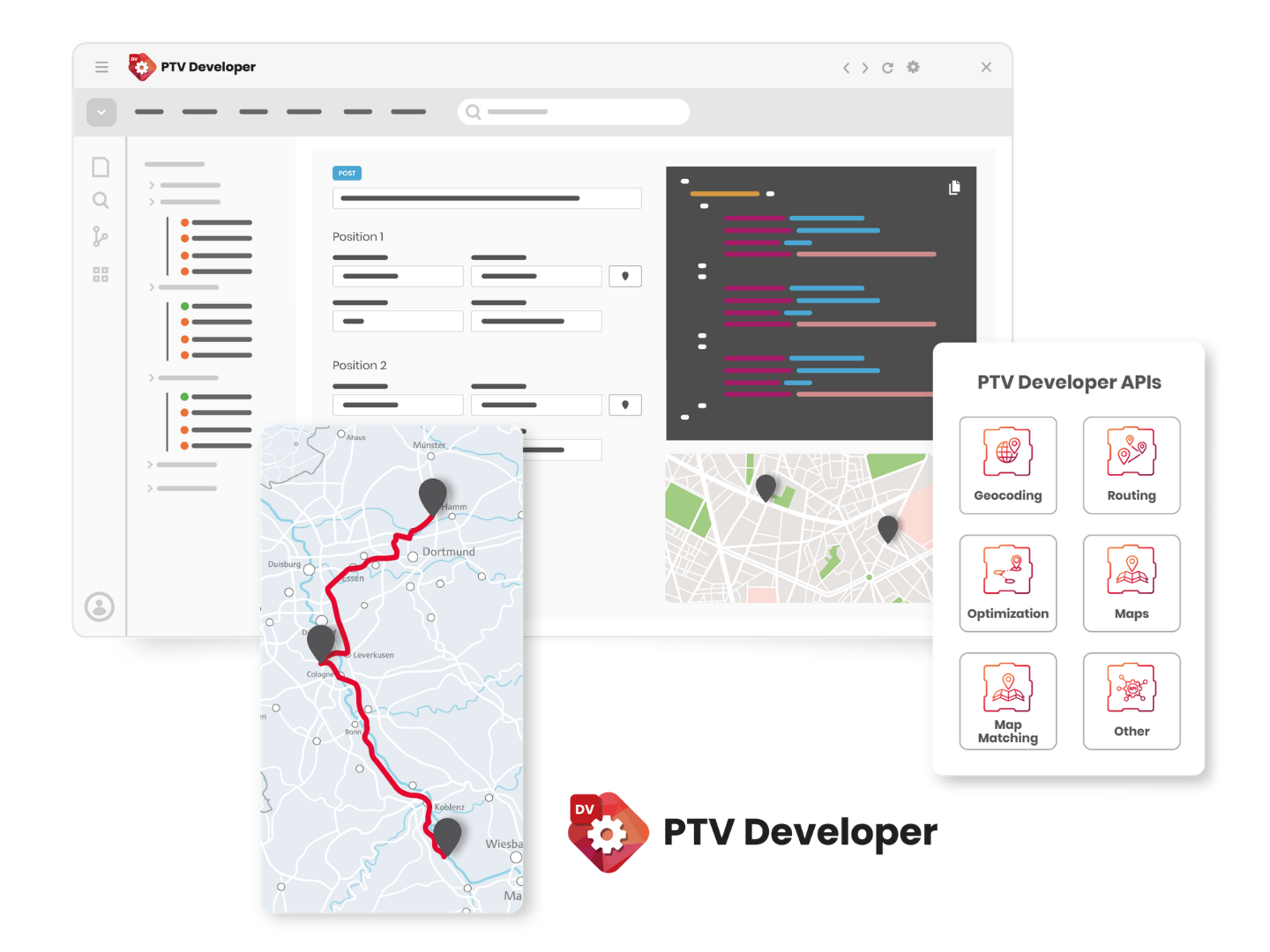
PTV Developer delivers the same optimization as APIs. It offers 17 individual APIs that can be mixed and matched, including Route Optimization APIs that support multi depot networks and model complex order and vehicle restrictions such as time slots and mixed fleets. It scales from 10 to 10,000+ daily routes, and its time dependent matrix service calculates up to 500 by 500 locations in a single synchronous call. Routing accuracy is within 5 to 10 percent of real world travel times. PTV Developer embeds into a TMS, ERP, WMS or custom application and is SAP TM ready. 

Explore PTV Developer 

PTV Mira adds a conversational layer on top of the same optimization engine. For daily multi depot planning, planners can ask why an order is unplanned or what happens if volume increases next Monday. For network decisions, leaders can ask which depot option performs best and why. PTV Mira turns each question into a real optimization run, compares the scenarios and explains the trade offs. 

Explore PTV Mira 

Replanning when the day changes 

Dynamic route optimization means rebuilding routes as conditions change: a new order arrives, a delivery is cancelled, a vehicle is delayed or traffic builds. At scale, replanning has to meet two demands at once. It must finish quickly enough to be useful, and it must change only what the new information affects, because drivers already on the road cannot be reshuffled every time something moves. 

PTV OptiFlow adjusts dynamically to incorporate new data and evolving operational requirements. Because replanning speed depends on the network, the data and the constraint mix, it is worth measuring on your own orders and not taking from a brochure. 

To know more about how daily execution connects to tactical and strategic planning, see transportation planning for freight and delivery networks. 

How to test a routing engine on your own data 

A demo on a small data set says little about behavior at scale. A pilot on your own orders says much more. Five checks are worth building into any evaluation: 

  1. Compare joint and separate depot planning.
    Run the same orders with depots planned separately, then together, and compare total miles and vehicle use. 
  2. Raise the volume.
    Increase the order count and watch whether run time and plan quality hold. 
  3. Change a few orders.
    Edit or cancel a handful of orders and count how many routes change. 
  4. Compare planned and actual travel times.
    Look at the gap by time of day, not only as a daily average. 
  5. Follow the data path.
    Check how orders arrive from the TMS or ERP and how plans return, including error handling. 

Frequently asked questions

Toggle accordion item
What is multi depot routing at scale? 

Multi depot routing at scale is the ability to build feasible, cost efficient routes for thousands of stops across several depots within a practical time limit, and to rebuild them quickly when orders, traffic or vehicles change. It matters once a network is too large to plan or check by hand. 

Toggle accordion item
What is the multi depot vehicle routing problem? 

The multi depot vehicle routing problem is the task of deciding which depot and vehicle serves each customer, and in what order, so that total cost is minimized while capacities, time windows and other rules are respected. It extends the classic vehicle routing problem, which has a single depot, and it is harder because depot assignment and routing influence each other. 

Toggle accordion item
Why does multi depot routing get harder as the network grows? 

Several things grow at once. The number of possible plans multiplies faster than the number of stops, travel time data grows with the square of the number of locations, and constraints interact. Within a fixed planning window the software has a far larger space to search, so the design of that search matters more. 

Toggle accordion item
How many stops can multi depot routing software handle? 

It depends on the constraints, the time limit and the plan quality you expect, so a single figure says little. PTV Developer scales from 10 to 10,000+ daily routes, and its time dependent matrix service handles up to 500 by 500 locations in one synchronous call. The dependable test is a run on your own orders at your own volume. 

Toggle accordion item
What should AI cover in route planning for big fleets? 

AI helps most where a network is too large for manual review: speeding up parts of the routing computation, evaluating more options in the same time and explaining results so planners can trust them. Decisions stay with people. PTV Mira, for example, runs real optimizations, explains the outcome and relies on people to approve every action. 

Toggle accordion item
How do routes stay stable when orders change during the day? 

A good replan changes only the routes that the change affects and leaves the rest in place, so drivers already on the road are not disrupted. PTV OptiFlow adjusts dynamically to new data and evolving operational requirements. When evaluating any tool, measure replan time and the number of routes that change on your own data. 

Toggle accordion item
Should we build our own routing engine or use an API? 

Building gives full control but also means owning solver research, traffic data, testing and maintenance for as long as the engine runs. An API platform moves that work to the provider while your team keeps its own workflow, planner interface and data model. PTV Developer is designed for this approach, with an API first architecture that embeds into existing systems. 

Test multi depot routing on your own network 

Bring your orders and depts and see how an integrated plan performs at your volume. 

Contact us