Search for content
AI & Scenario Planning

AI in route optimization

It is 5:45 a.m. at a regional retail distributor. The transport planner has 240 stops to cover from three depots. Two drivers called in sick overnight, a key customer pulled its delivery window forward by two hours, and a road closure is expected on the ring road. The plan that looked fine yesterday no longer does. Situations like this are why logistics leaders ask what AI can do for route optimization. The answer has several parts. AI can improve the data a route plan is built on, speed up analysis, and let planners ask questions in plain language. It cannot, by itself, guarantee that a plan respects every time window, vehicle capacity, and driver rule. Knowing which job belongs to which technology is what makes an AI project useful. 

The need for that clarity is real. In August 2026, Gartner reported that more than half (55%) of chief supply chain officers are unclear on the return on investment from AI. This page explains where AI earns its place in route planning, where its limits are, and how to judge what vendors offer.

Talk to a logistics expert

What is AI route optimization? 

AI in route optimization is the use of machine learning and conversational AI alongside an optimization engine to improve the data a plan is built on, speed up analysis, and help planners understand and compare route options. 

An optimization engine, often called a solver, searches through the enormous number of ways to assign stops to vehicles and sequence them. It returns a plan that respects the rules you set, such as time windows, capacities, driver breaks, and depots. AI route planning works around that engine in three places: 

  1. Before the plan: better data 
    Service times learned from delivery history, cleaner addresses and coordinates, and demand forecasts give the engine inputs that match reality. A plan can only be as realistic as the data behind it.
  2. During the plan: faster analysis 
    Pattern recognition across traffic, parcel density, and service failures helps planners spot routes that repeatedly run late and vehicles that are consistently underused. 
  3. Around the plan: conversation 
    Conversational AI lets a planner ask a question in plain language, such as which depot performs best, and receive a worked answer instead of a new set of parameters to configure. 

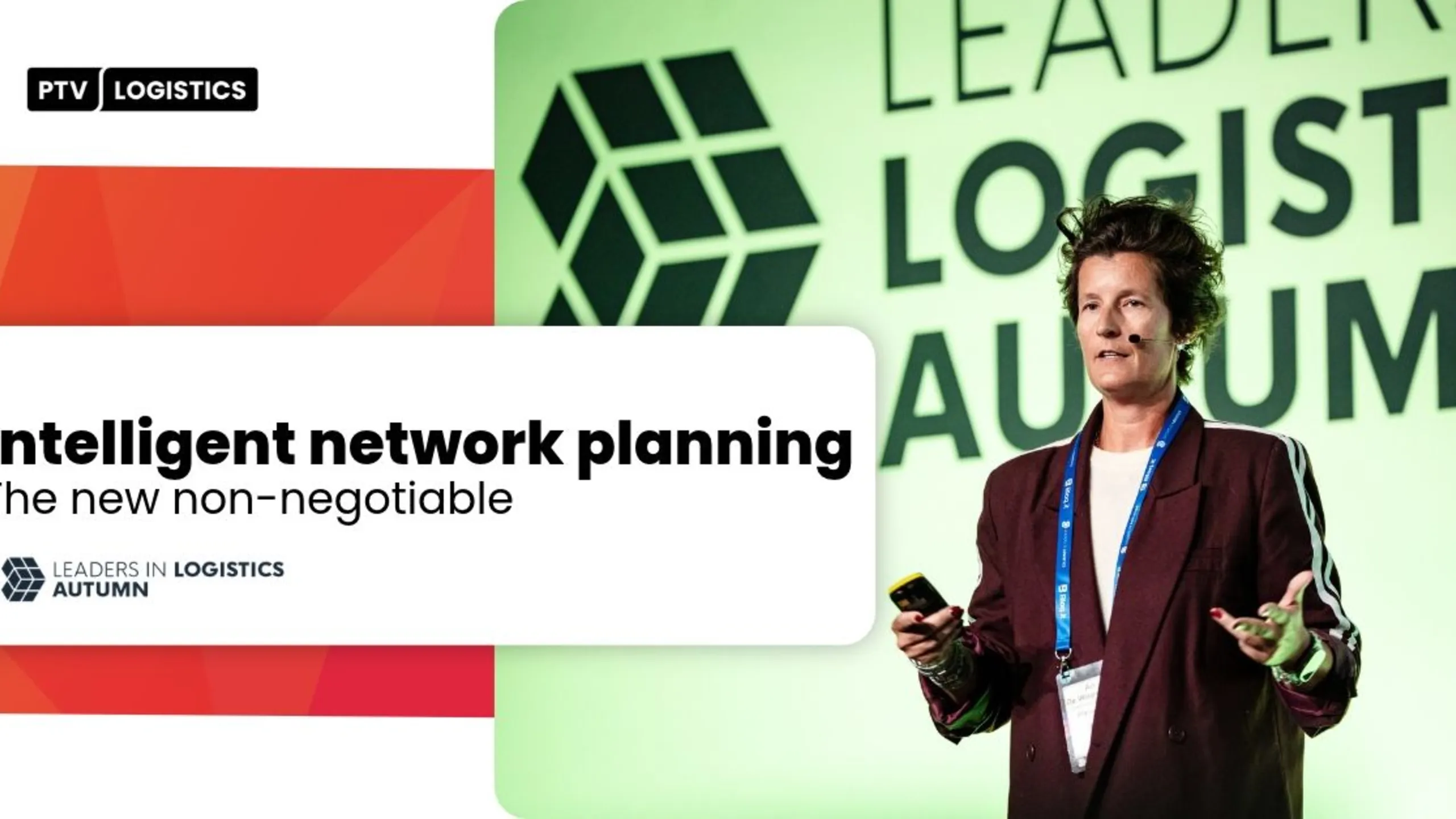
For a closer look at how and why conversational route optimization is changing decision making, watch An De Wispelaere, Chief Innovation Officer at PTV Logistics, in her keynote at the Leaders in Logistics Summit 2026.

Aspect

Traditional route optimization 

AI-assisted route optimization

Planning dataMaster data and average service times maintained by hand Service times and locations improved from delivery history 
Demand and trafficFixed assumptions or manual adjustmentsForecasts and learned patterns feed the input
Analysis of results Planner reviews plans and executed routes manuallyPattern detection flags recurring late routes and idle capacity 
InterfaceParameters and settings, often handled by expert users Questions in plain language
Who builds the planOptimization engine Optimization engine
Who decides Planner Planner

The last two rows matter most: In a well designed setup the engine still builds the plan and people still approve it. AI improves what goes in and how people work with what comes out. 

Where AI stops: limits and risks to plan for  

Every use of AI for route optimization brings requirements and risks. Route planning teams should weigh these before they commit. 

  • Data volume and quality. Learning useful patterns takes large amounts of history, and incomplete or inconsistent data leads to inaccurate results. 
  • Computing cost. AI methods can need significant computing resources, which can become a bottleneck on large routing problems. 
  • Problem complexity. Real networks combine traffic, weather, capacity, time windows, and driver rules. AI approaches tend to deliver satisfying results on simpler cases today. 
  • Transparency. Some AI models are hard to interpret, which makes it difficult to see why a route was recommended or to correct an error. 
  • Dependence on history. Models trained on past data can mislead when conditions change, for example after a new depot, a new customer mix, or a new regulation. 

A language model can interpret a request and summarize a result in clear language. Checking that a plan is feasible across every vehicle, stop, and rule is the work of an optimization engine, which is why conversational AI works best when it sits on top of one. 

Also read: AI for route optimization: pros, limits, and risks

See what AI supported planning could do for your network

Start with an estimate, then test it against your own data and constraints with a logistics expert. 

Calculate your savings

How PTV Logistics applies AI to route optimization 

PTV Logistics applies AI where it strengthens the inputs to a plan and the way people work with it. The plan itself comes from an optimization engine built on more than 40 years of routing expertise. This has a practical benefit. Because the engine builds every plan from an explicit cost model, planners can trace why a route looks the way it does, and an unexpected result points back to the inputs. 

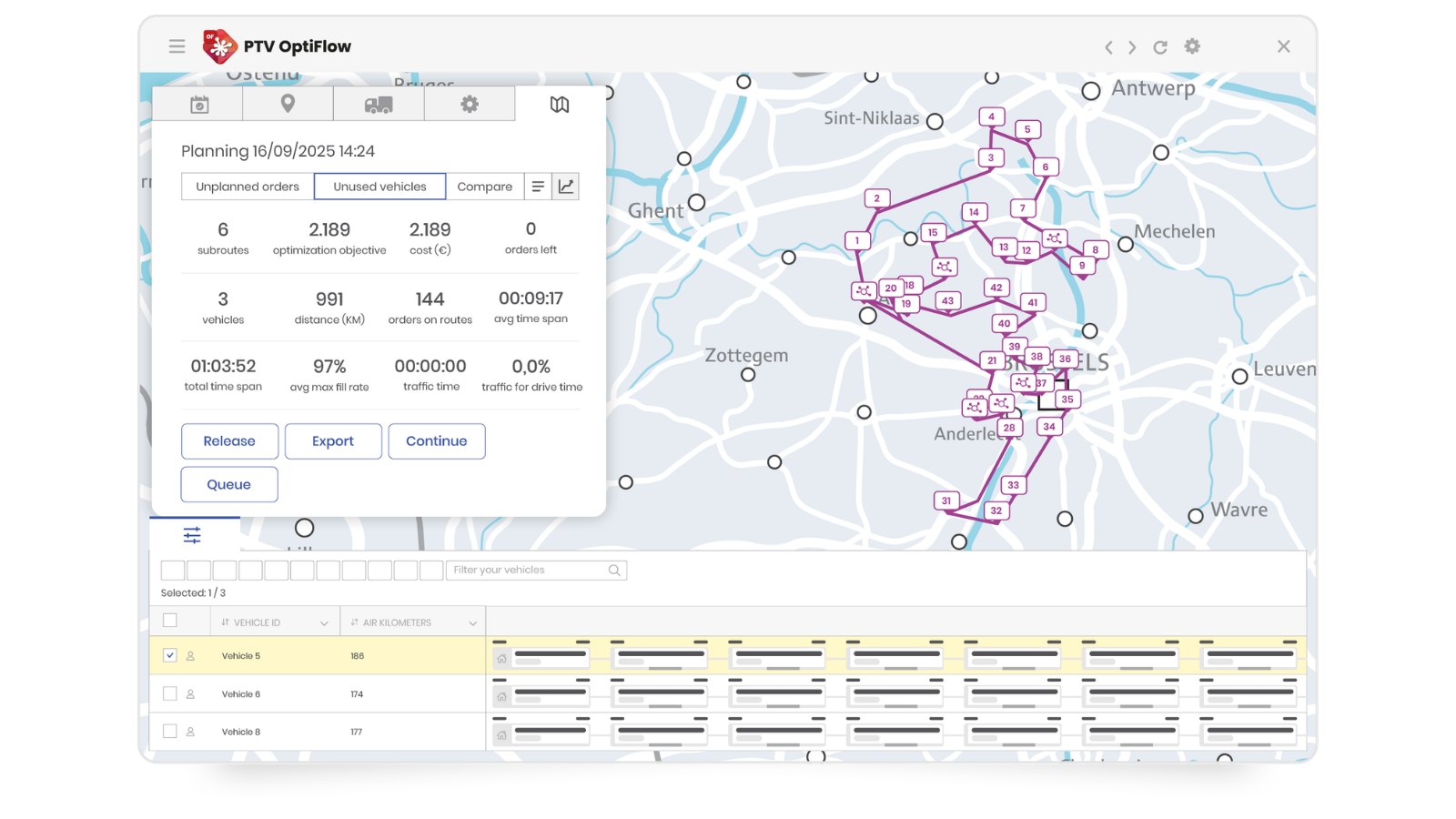
PTV OptiFlow: the optimization engine

PTV OptiFlow generates route plans that respect real constraints such as time windows, vehicle capacity, driver breaks, multiple depots, and skills. It uses time dependent traffic models based on historic traffic patterns, so plans reflect how roads behave at different times of day. It covers daily routing, tactical planning, and network design in one platform, so the same engine supports the 5:45 a.m. re-plan and next year's depot decision. 

Discover PTV OptiFlow 

PTV Mira: the conversational layer

PTV Mira lets planners and decision makers ask questions in plain language, such as "What happens if volume increases next Monday?" or "Which depot option performs best, and why?" She turns each question into real optimization scenarios, compares the alternatives across cost, service, and CO₂, and explains the result. PTV Mira supports decisions without making them. Users approve every action, and the final decision stays with the planner. 

Explore PTV Mira

PTV Developer: the API layer for your own systems

Teams that want optimization inside an existing TMS, ERP, or WMS can use PTV Developer. It provides the same routing and optimization services through APIs, including route optimization that handles time windows, capacities, and breaks, plus geocoding for accurate locations. It is also the service layer behind the simulations PTV Mira runs. 

Explore PTV Developer

How to evaluate AI route optimization software 

Vendors use the word AI for very different things. These six questions help you compare what each one actually means. 

  1. What does the AI do, specifically?
    Ask whether it improves inputs, forecasts demand, analyzes results, powers a chat interface, or generates the plan itself. 
  2. Which component builds the plan, and can you see the cost model behind it?
    You should be able to trace why a route was chosen. 
  3. Who approves actions?
    Ask for approval steps and override rules in writing. 
  4. What data and how much history does it need?
    Ask what happens when data is sparse or inconsistent. 
  5. How does it connect to your TMS, ERP, and WMS?
    Ask which APIs exist and how much integration effort to expect.
  6. How will you measure results?
    Agree a baseline before any pilot, such as planner hours, cost per stop, on time delivery, and miles driven, and compare against it.

Read more: Route optimization software: 5 steps to choosing the right solution  

Built for high-volume, constraint-heavy networks 

Our customers benefit most from our AI solutions when their teams plan 50 or more vehicles across multiple depots or regions, manage dense stops and frequent exceptions and work with multiple constraints. Teams gain even more when planners also need to connect optimization to an existing TMS, ERP or WMS. 

Better routes, faster planning and lower costs 

PTV OptiFlow turns complex route planning into measurable operational gains. It helps teams finish plans sooner, use vehicles more efficiently and cut unnecessary mileage. Customers achieve: 

Cost control

Up to 30% lower transport costs

Delivery time

Up to 80% less planning time

CO2 emissions

Up to 20% lower CO₂ emissions

Those gains come from everyday improvements: planners finish sooner, fleets travel fewer unnecessary miles and teams use available capacity more effectively. The exact result depends on each network, data set, constraint mix and starting point.

Turn complex route questions into clear, actionable decisions 

See how PTV Logistics applies AI-enhanced optimization, conversational analysis and human approval to your planning priorities. Compare the effects on cost, service, CO₂ and integration requirements in one transparent workflow. 

Book a demo

More on AI in logistics planning

FAQs about AI route optimization

Toggle accordion item
What is AI route optimization?

AI route optimization is the use of machine learning and conversational AI alongside an optimization engine to improve planning data, speed up analysis, and help planners understand and compare route options. The optimization engine builds the plan, and AI improves what goes into it and how people work with the result. 

Toggle accordion item
How does AI improve route optimization?

AI improves route optimization mainly by making the inputs to a plan more realistic and the results easier to analyze. Examples include learning service times from delivery history, improving address parsing and geocoding, forecasting demand to size resources, flagging routes that repeatedly run late, and letting planners ask what if questions in plain language. The size of the benefit depends on your data and your starting point. 

Toggle accordion item
What is the difference between AI-powered and traditional route optimization algorithms?

Traditional route optimization relies on a solver working from the master data and rules you provide, while AI-powered approaches add learning from data, forecasting, pattern recognition, or a conversational interface around that solver. A common approach combines both, with the solver building the plan and AI improving the inputs or the interaction. Ask any vendor which of these its AI covers. 

Toggle accordion item
How much fuel or cost can AI-driven route planning actually save?

There is no universal figure, because savings depend on your starting point: how routes are planned today, how complete your data is, and how complex your constraints are. The reliable way to find out is a pilot against a documented baseline that compares miles, cost per stop, and planner time. Our guide on how to manage fleet fuel costs explains how to calculate and benchmark fuel spend and how route planning changes it. 

Toggle accordion item
What should AI cover in route planning for large fleets?

For large fleets, AI route planning should support four jobs: improving planning data such as service times and locations, forecasting demand and traffic effects, flagging recurring problems in executed routes, and letting planners test scenarios quickly. The plan itself should come from an optimization engine that handles your real constraints, such as time windows, capacities, multiple depots, and driver rules, and it should connect to your TMS, ERP, or WMS. 

Toggle accordion item
Can AI replace route planners and dispatchers?

No. AI can take over analysis and routine recalculation, but planners hold knowledge about customer promises, service priorities, and workforce realities that models do not have. With PTV Mira, users approve every action and the final decision stays with them. 

Toggle accordion item
Can AI simulate network scenarios through natural language questions?

Yes. PTV Mira lets users ask questions in plain language, such as which depot option performs best or what happens if volume increases next Monday. She turns each question into real optimization scenarios, compares the alternatives on cost, service, and CO₂, and explains the result. Users approve every action.