Search for content
AI & Scenario Planning

AI in transport and logistics

Your planners make thousands of interconnected decisions every day. Teams coordinating 50 or more vehicles across multiple depots balance tight time windows, SLA commitments, vehicle capacity, driver rules, transport cost and CO₂ targets. When customers add late orders or volumes change, planners still have to keep routes on track through the TMS, ERP or WMS that already runs the operation. 

Implementing AI in transport and logistics delivers the decision support your teams need to act quickly and efficiently. PTV Logistics combines AI-enhanced optimization with decision intelligence so planners compare scenarios, see the assumptions and trade-offs behind the results and approve every action. That way, your teams move from faster route calculation to clearer, human-controlled transport decisions.

Talk to a logistics expert

Where AI actually helps in transport planning today 

AI in transport and logistics means applying AI-enhanced computation and machine learning to route planning and scenario analysis — speeding up calculations, surfacing patterns in operational data, and improving the inputs a plan relies on, while every recommendation stays explainable and subject to human approval. 

Your planning teams get the most value from AI when they need to process more constraints, learn from execution data and test more options within a fixed planning window.

  • Faster VRP computation: AI accelerates parts of vehicle routing problem computation, giving teams time to evaluate more options across large fleets, multiple depots and dense constraint sets. 
  • Stronger pattern recognition: Machine learning identifies recurring signals in traffic, stop sequencing, service failures and driver or resource behavior, so planners see what affects plan quality. 
  • Better master data: AI uses execution history to improve the master data behind future plans, including real, time-dependent delivery durations and differences between drivers, resources or locations. 
  • Cleaner location inputs: AI-assisted geocoding parses incomplete or inconsistent addresses and interprets natural-language inputs, including spoken or handwritten address data. Planners start with cleaner location data and spend less time correcting inputs. 
  • More robust planning: Planners use patterns from past operations to estimate delivery costs and service levels, prepare for likely disruptions and allocate vehicles and drivers more effectively. 

The real limits and risks of AI in logistics planning 

AI route optimization has practical limits. Data readiness, computing resources, problem complexity and clear decision controls all affect whether an output is useful in a live operation. 

  • Data volume and quality: Machine learning needs enough relevant history to identify useful patterns. Incomplete, inconsistent or outdated data leads to weak recommendations or reinforces errors already present in the planning process. 
  • Computational cost: Large vehicle routing problems with real-world constraints require significant computing power. Teams still have to balance solution quality with the time available to produce an operational plan. 
  • Problem complexity: Planners get reliable answers only when the model represents the full operating problem. An approach that works well for a simple, single-depot plan often needs more data and calculation time when thousands of stops, tight time windows, driver regulations and changing orders interact. 
  • Black-box risk: Planners need to see which assumptions and trade-offs led to a proposed route. Without that visibility, they struggle to challenge errors, explain a decision or govern the planning process. 
  • Overreliance on history: Planners need to recognize when past data no longer reflects current volumes, customer behavior, regulations or network conditions. They should treat historical patterns as useful evidence, not an automatic source of truth. 
  • Planner judgment, not just data: Demand for supply-chain roles that require AI skills has risen 387% since 2023, while 83% of organizations still apply AI to specific use cases rather than a full operational redesign. An AI system is only as useful as the planners available to interpret and supervise it — which is why PTV Logistics keeps every recommendation explainable rather than automatic. 

Before investing, your operations and IT teams should test the system with realistic order volumes, depots and constraints. They should check data quality, explanations, approval controls, calculation time and behavior when inputs are incomplete or conditions change. 

How mature is your planning & optimization?

Not sure where your operation stands today? PTV Logistics' planning & optimization maturity assessment takes about three minutes and shows where you could unlock more efficiency, visibility and automation. 

Assess your planning maturity

From algorithms to decision intelligence 

Decision intelligence helps planners choose among valid route plans by making the operational trade-offs explicit. 

An optimization solver is the calculation engine that builds feasible routes from your orders, vehicles and constraints. It processes thousands of stops, but planners need more than one valid route. They need to know whether a lower-cost plan puts an SLA at risk, whether a service improvement requires more vehicles or whether a CO₂ reduction changes capacity, mileage or driver hours. 

AI speeds up the calculations and identifies patterns. The software then uses prescriptive analytics to show planners how each option changes cost, service and CO₂. Planners add customer priorities, local knowledge and operational judgment before choosing the trade-offs their network accepts. 

Planners no longer spend most of their time waiting for a route calculation. The harder job is interpreting the options and choosing the right trade-offs. When the software explains each scenario clearly, your team understands what changes, approves the plan with confidence and explains the decision to the wider operation. 

Why conversational AI matters in logistics 

Experienced planning and operations teams use conversational AI to access optimization and scenario analysis through natural-language questions. 

Planners ask questions in everyday operational language instead of rebuilding models or hunting through dashboards. They investigate why an order remains unplanned, test next week's volume change or compare depot options. PTV Mira connects each question to a real optimization run, simulation or root-cause analysis, then shows the assumptions and operational effects behind the answer. 

That gives planners faster answers when today's plan changes. It also lets logistics leaders test fleet capacity, territories or depot structures and see the effects on routes, cost, service and CO₂. 

Meet PTV Mira

PTV Mira is PTV Logistics' conversational decision-intelligence layer, built on more than 40 years of optimization expertise. It translates natural-language questions into real optimization runs, simulations and scenario comparisons, then explains the results and trade-offs. 

A planner asks questions such as: 

  • 'Why is this order unplanned?': PTV Mira analyzes the relevant constraints and optimization results to help identify the root cause of an unassigned order. 
  • 'What if next week's volume increases by 15%?': PTV Mira runs a what-if scenario using the operational model and compares the results. 
  • 'What if we open a new depot?': PTV Mira supports strategic scenario analysis across fleet, territory and depot choices. 


AI Recommendations, Human Decisions

Through the same conversation, planners move from investigating a problem to adjusting daily routes or running a strategic scenario. 

PTV Mira does not make autonomous decisions — this is deliberately different from agentic AI that acts on its own. Every action requires user approval. The user remains in control and reviews the reasoning, assumptions, alternatives and trade-offs before anything changes.

Explore PTV Mira

The optimization engine: PTV OptiFlow

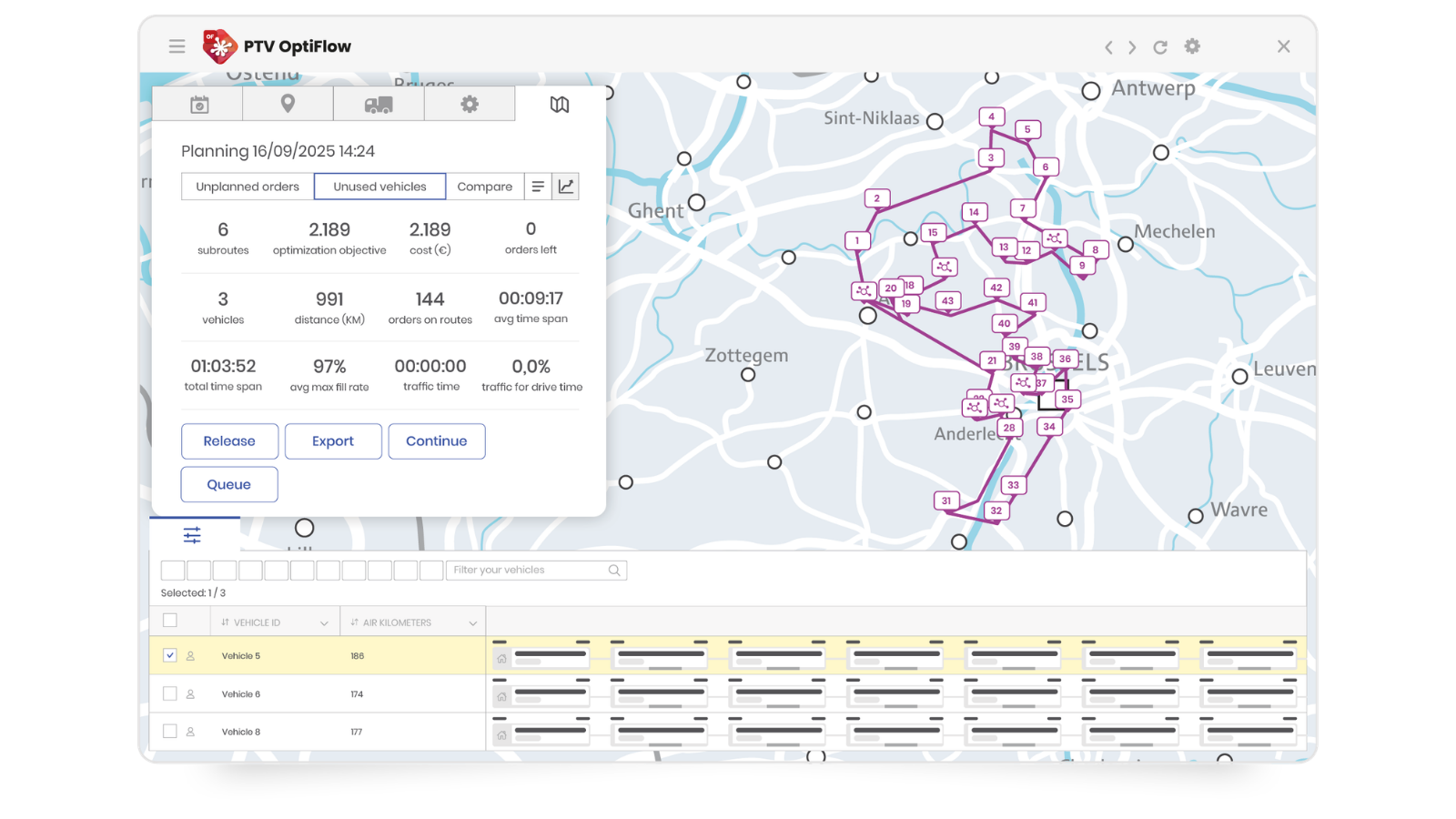
PTV OptiFlow is the fully automated route optimization solution that turns your orders, vehicles and constraints into realistic, cost efficient plans, built on more than 40 years of PTV Logistics optimization expertise. It gives AI driven tools like PTV Mira a real optimization engine to work with, and it gives your planners a dependable plan before the day begins. 

  • Advanced optimization on a large scale: PTV OptiFlow automates complex planning across multiple stops, multiple depots and dense constraints such as time windows and SLAs. Planners get high quality plans for large networks without loosening the rules that protect service.
  • Traffic realism built in: Historic traffic patterns combined with models that reflect how conditions change through the day shape every route. Plans hold up on the road, which means fewer failed deliveries, less overtime and less replanning. 
  • Planning logic you define: You decide what cost means for your operation, whether that is time, distance, capacity or workload. PTV OptiFlow optimizes against your definition and can level workload across docks and time slots.

These capabilities give planners more realistic inputs and faster answers across strategic, tactical and daily planning. Your team still sees how PTV OptiFlow reached each result, so experts stay in control of the final plan. 

Discover PTV OptiFlow 

The engine behind it: PTV Developer

PTV Developer delivers PTV OptiFlow's AI-enhanced route optimization and geocoding as cloud-native APIs — the same logistics intelligence your planners use, embedded directly into your TMS, ERP, WMS, or custom application. Teams send planning inputs to the relevant API and get results back into their existing workflow, without rebuilding route-planning logic or replacing systems already in place.

Explore PTV Developer

How PTV Logistics keeps people in control 

PTV Logistics' AI does not make autonomous decisions. Every action requires human approval. 

Our AI-driven solutions accelerate computation, recognize patterns, enrich data and make scenarios easier to explore. Assumptions remain visible and results remain explainable, so your planners challenge, compare and approve recommendations before they affect the operation. 

PTV Logistics focuses AI on transport and route planning, with no unsupervised action. Your planners see why the system recommends each option and approve every change before it reaches the operation. 

Built for high-volume, constraint-heavy networks 

Our customers benefit most from our AI solutions when their teams plan 50 or more vehicles across multiple depots or regions, manage dense stops and frequent exceptions and work with multiple constraints. Teams gain even more when planners also need to connect optimization to an existing TMS, ERP or WMS. 

Better routes, faster planning and lower costs 

PTV OptiFlow turns complex route planning into measurable operational gains. It helps teams finish plans sooner, use vehicles more efficiently and cut unnecessary mileage. Customers achieve: 

Cost control

Up to 30% lower transport costs

Delivery time

Up to 80% less planning time

CO2 emissions

Up to 20% lower CO₂ emissions

Those gains come from everyday improvements: planners finish sooner, fleets travel fewer unnecessary miles and teams use available capacity more effectively. The exact result depends on each network, data set, constraint mix and starting point.

Turn complex route questions into clear, actionable decisions 

See how PTV Logistics applies AI-enhanced optimization, conversational analysis and human approval to your planning priorities. Compare the effects on cost, service, CO₂ and integration requirements in one transparent workflow. 

Book a demo

AI insights for logistics leaders

FAQs about AI in transport and logistics

Toggle accordion item
What is AI in transport and logistics?

AI in transport and logistics means applying AI-enhanced computation and machine learning to route planning and scenario analysis — speeding up calculations, surfacing patterns in operational data, and improving the inputs a plan relies on, while every recommendation stays explainable and subject to human approval. 

Toggle accordion item
How is AI actually used in route optimization and transport planning today?

AI accelerates VRP computation, identifies patterns in routing and execution data, enriches master data, improves geocoding and tests what-if scenarios. In enterprise networks, planners use these capabilities for multi-depot plans with time windows, capacities, skills, territories and driver regulations while tracking effects on cost, service and CO₂. 

Toggle accordion item
What are the biggest limitations of AI route optimization?

The main limits are data quality, data volume, computing cost, problem complexity and explainability. AI is not a substitute for operational expertise, and outputs require human review when assumptions, regulations or network conditions change. 

Toggle accordion item
What is the difference between an algorithm and decision intelligence?

An algorithm calculates an answer. Decision intelligence helps a planner understand which answer to choose by showing assumptions, alternatives, trade-offs and operational consequences. 

Toggle accordion item
Will AI replace transport planners and dispatchers?

No. AI supports heavy computation, pattern detection and scenario generation, but planners and dispatchers still set priorities, interpret exceptions and approve actions. PTV Logistics uses a human-in-the-loop approach so the people accountable for the plan retain control. 

Toggle accordion item
How does PTV Mira work?

PTV Mira translates a natural-language question into a real optimization run, simulation or scenario comparison. It analyzes the result, explains the trade-offs and presents proposed actions for user approval. 

Toggle accordion item
How does AI help when historical data changes?

AI improves plan quality and realism when teams use execution data to enrich the master data behind future plans. The Learn loop captures time-dependent delivery durations and operational differences, while AI-assisted geocoding improves ambiguous inputs. Planners still validate historical patterns as conditions change.